
No products in the cart.


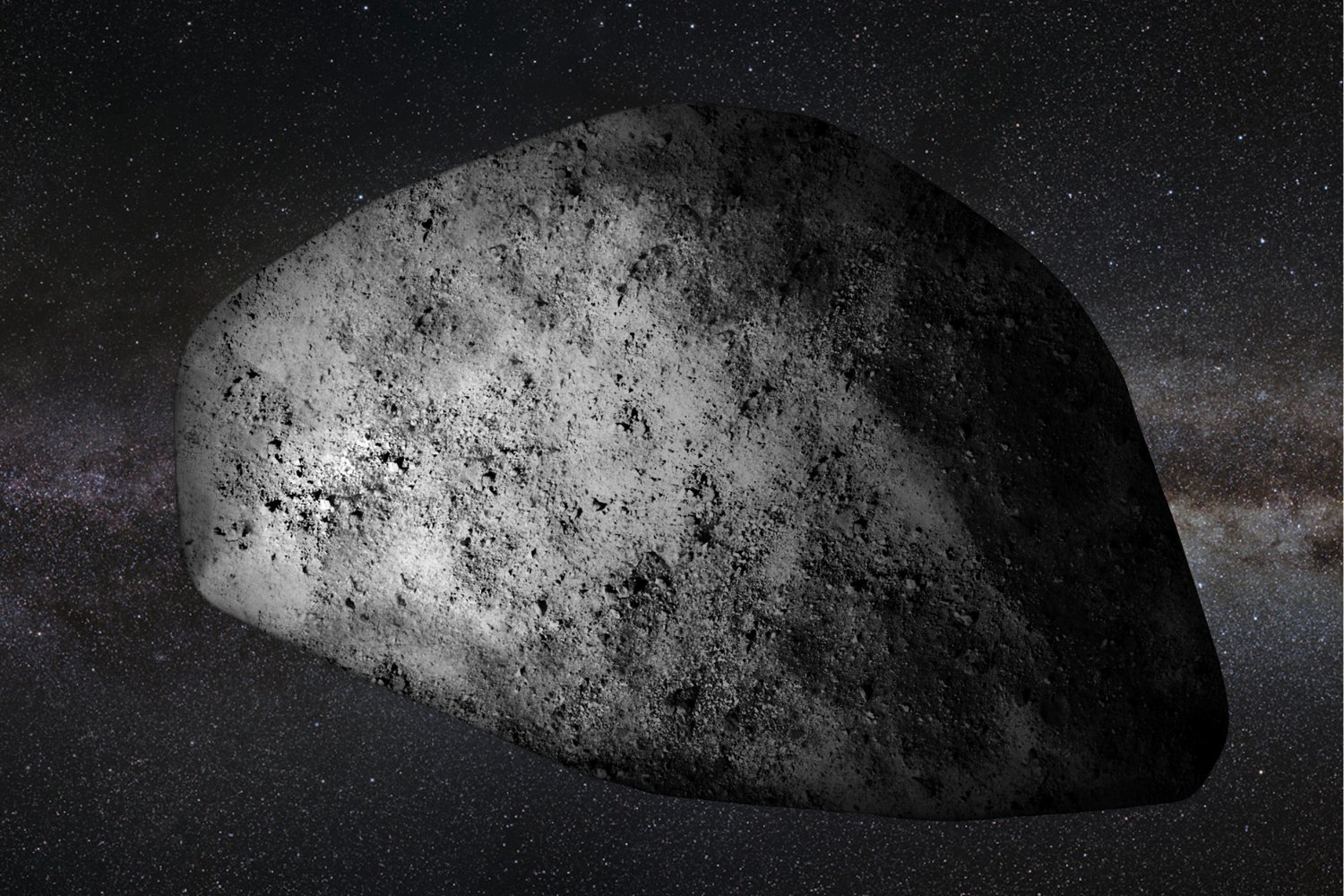
A group of astronomers imagine that our planet’s gravitational pull may alter the floor of Apophis, a near-Earth asteroid (NEA) set to make an in depth method to Earth in 5 years’ time.
Apophis is presently 1.97 astronomical models from Earth—or about twice as removed from Earth as our planet is from the Solar. However in April 2029, the asteroid will swing proper by our planet, and a group of researchers believes that the encounter will trigger landslides and quakes on the smaller rock. The group’s findings are set to publish in The Planetary Science Journal and are presently hosted on the preprint server arXiv.
“The 2029 encounter will induce short-term tidally-driven discrete seismic occasions that result in high-frequency floor accelerations that attain magnitudes much like Apophis’ gravity, and which may be detectable by trendy seismometers,” the researchers wrote within the paper.
Area scientists are paying shut consideration to Apophis’ April 13, 2029 flyby (and sure—April 13, 2029 is a Friday). When it makes its nearest go, the 1,100-foot-wide (335-meter-wide) asteroid will probably be inside 24,000 miles (38,625 kilometers) of our planet’s floor—roughly ten instances nearer than the Moon’s standard distance in its orbit by our cosmic neighborhood.
That proximity to Earth signifies that Apophis will probably be altered by the gravitational pull of our planet, the identical drive that retains the Moon in orbit round us. However Apophis is far smaller than the Moon, and will probably be nearer to Earth, so Earth’s gravity could have a extra excessive influence on the asteroid. This is similar drive that causes stress and fracture marks on the floor of moons like Uranus’ Miranda, and raises questions in regards to the stability of our personal Moon, which might want to have a gentle sufficient floor for NASA to soundly land astronauts through the upcoming Artemis 3 mission.
“We additionally discover there will probably be a big change in Apophis’ tumbling spin state that would result in longer-term floor refreshing in response to tumbling-induced floor slope adjustments,” the group wrote, including that such a mechanism may refresh the surfaces of different asteroids like Apophis.
This facet of the group’s discovering is compelling, as a result of scientists can be taught loads from the interiors of asteroids. These hidden asteroid bits can reveal each the origins of the area rocks, but additionally the historical past of our photo voltaic system and past. Natural molecules in asteroids can trace at sources of life’s constructing blocks, and the metals within the rocks can point out the intense cosmic interactions that induced the asteroid to type. Asteroid interiors can supply layers of extra historical details about the content material of an area rock and the way in which it interacts with its native atmosphere in area, and clarify why some objects—just like the peculiar interstellar interloper ‘Oumuamua—accelerate like spaceships.
Like ‘Oumuamua, Apophis is predicted to swing by Earth. In all-but-the-slimmest chance, Apophis just isn’t a risk to life on Earth. A lot would have to go wrong for the asteroid’s trajectory to vary in a method that might put it on a collision course with our planet.
That stated, objects round Apophis’ measurement hit our planet as soon as each 80,000 years or so, and their impacts trigger grievous injury within the fast neighborhood of their influence, but additionally could cause chilling adjustments to the local weather. A 2021 NASA analysis discovered that Apophis’ trajectory received’t threaten our planet—that means not even the slightest likelihood of hurt—for at least a century.
Earlier this year, area firms together with Blue Origin proposed missions to capitalize on the asteroid’s brush with Earth. In any case, area companies are basically cosmic medical doctors making dwelling visits; it’s very uncommon—and less expensive—when the affected person involves you.
However neglect mission ideas, for a second—there’s already one mission heading off to rendezvous with Apophis. NASA’s OSIRIS-APEX mission is on its way to the asteroid to higher perceive how the rock could also be remodeled by its shut encounter with our planet.
If it have been to hit Earth—which it received’t—Apophis’ footprint would match neatly inside Manhattan’s Battery Park (as proven above). The final important asteroid to achieve Earth was the Chelyabinsk fireball—a rock in regards to the measurement of a small constructing that exploded over Russia in 2013. The explosion released energy equivalent to approximately 500 kilotons of TNT, inflicting a vibrant flash and a strong shockwave. The Chelyabinsk asteroid was simply 66 toes throughout (20 meters)—about 17 instances smaller than Apophis.
Nonetheless, that comparability showcases the potential hazard of near-Earth asteroids, and the rationale companies like NASA watch them so carefully. Although by the current group’s measure, Earth will trigger rather more havoc on Apophis than the asteroid will on our planet.


